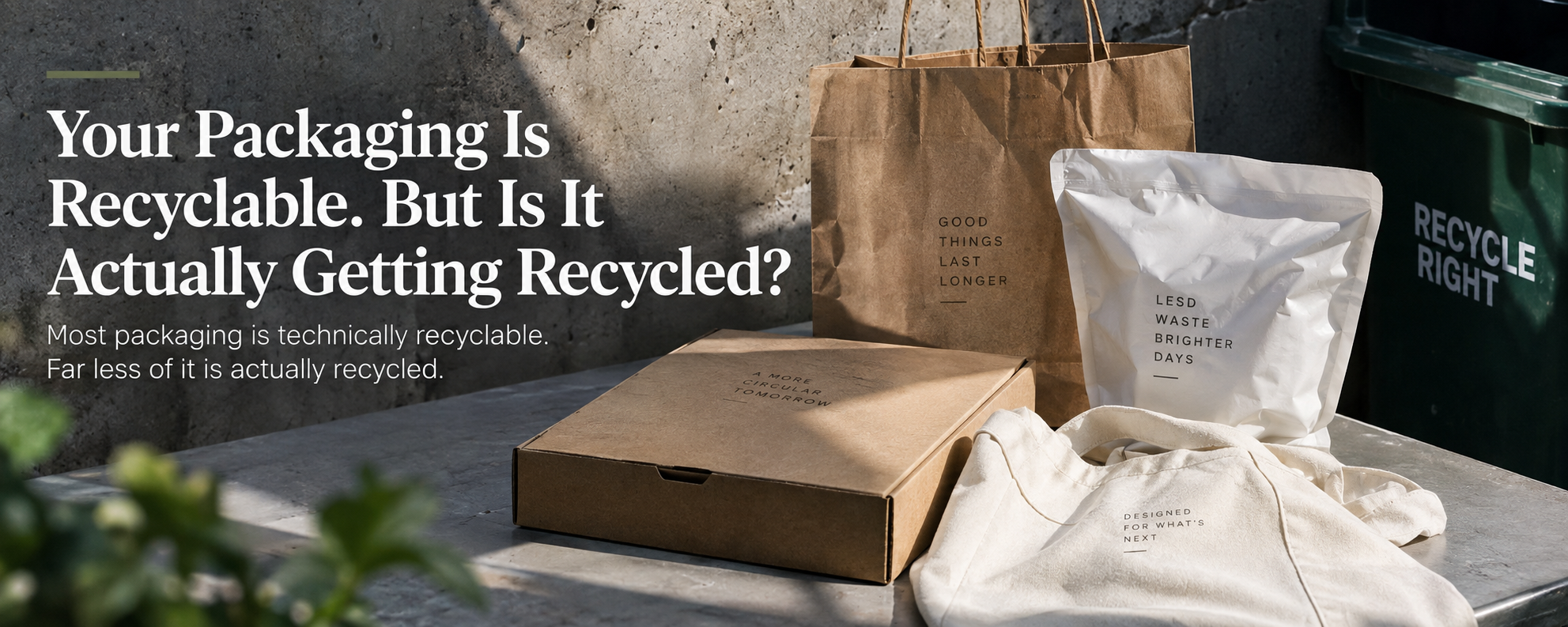
Your Packaging Is Recyclable. But Is It Actually Getting Recycled?
Most packaging today is designed to be recyclable. Far less of it is actually recycled.
That gap isn’t always a materials problem. It’s often a design problem.
Sustainability conversations in packaging tend to focus on inputs: recycled content, FSC certifications, bio-based alternatives. All important. But the teams getting ahead of the curve are asking a more operational question:
What actually happens to this packaging when the customer is done with it?
End-of-life design is a set of decisions made at the design stage that determine whether a package gets recycled, reused, or landfilled. Increasingly, this is where sustainability claims are either validated or exposed.
The Circularity Opportunity: Reuse, Refill, and Take-Back

The most forward-thinking brands are no longer treating packaging as a one-use proposition.
Circular models — refill systems, take-back programs, reusable formats — extend the value of a package beyond a single transaction. This is where the sustainability equation shifts.
The most sustainable package isn’t always the one that’s recycled. It’s the one that never becomes waste.
Reusable packaging performs best when it is engineered for longevity from the outset. Durable construction, cleanable surfaces, and structural integrity all matter — and they need to be built into the specification from the start, not added as finishing details.
Nuuly’s subscription clothing rental service illustrates what this looks like in practice. Rather than continuing to ship orders in corrugated boxes — which were sustaining damage and generating material waste through repeated use — Nuuly worked with Prime Line to develop a soft, collapsible packaging case made from eco-friendly materials. The result is a format designed from the outset for the return journey: it ships outbound, comes back with the rental, collapses flat for storage, and goes out again.
That outcome required three things to be resolved at the design stage: material durability, collapse efficiency for return logistics, and enough visual appeal that the format reinforced the brand on every cycle.
The same principle applies to any take-back system. Packaging that uses single materials, survives return logistics, and stores compactly is far more likely to scale operationally. Designs that require disassembly or can’t withstand multiple use cycles rarely do.
👉 Define the intended end-of-life pathway early, and design toward it.
Making Disposal Messaging Actually Work
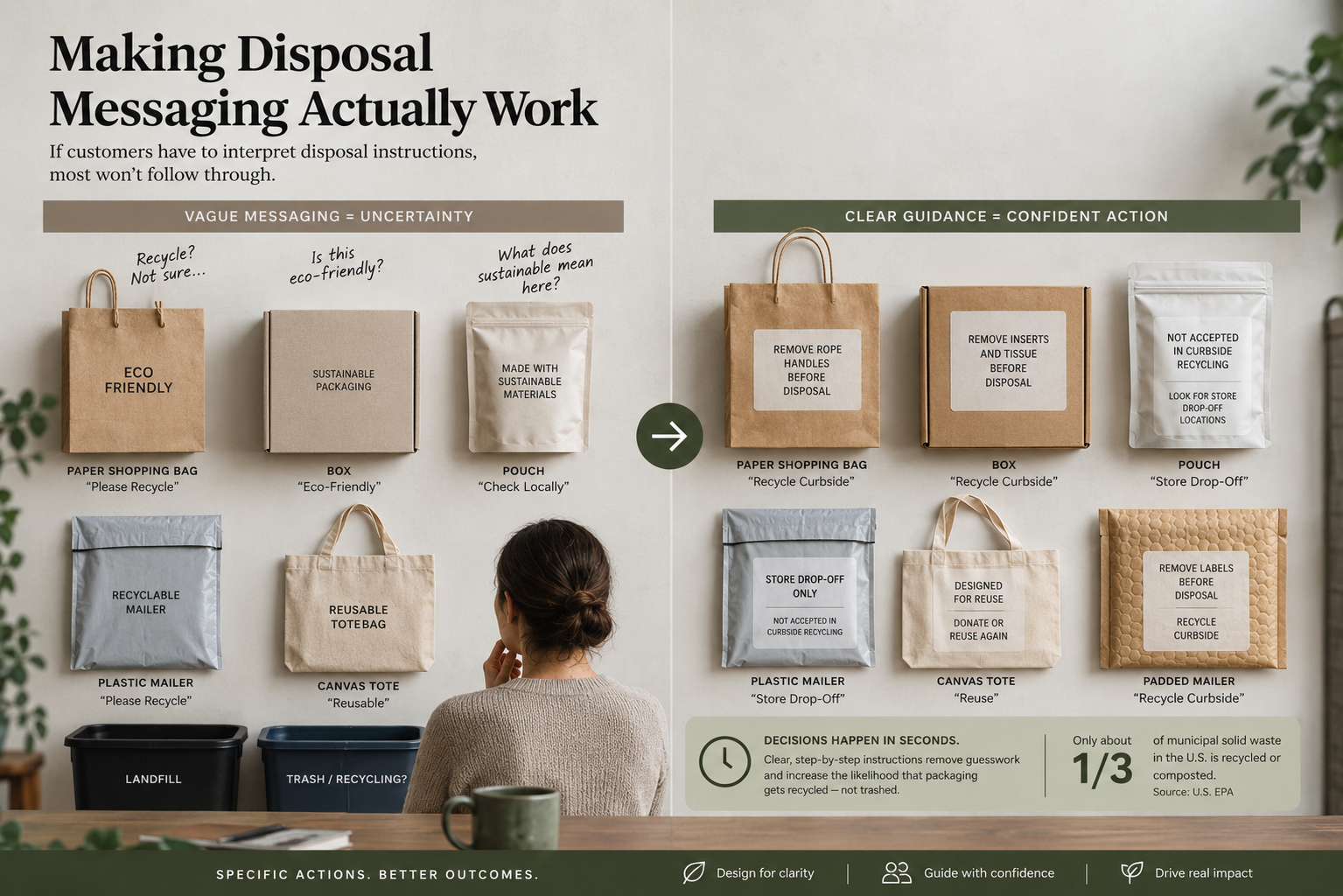
There is a persistent gap between packaging that is technically recyclable and packaging that is actually recovered. Clarity is the main constraint.
According to the U.S. Environmental Protection Agency, only about one-third of municipal solid waste in the United States is recycled or composted. That figure has remained largely flat for years — not because consumers don’t care, but because disposal decisions happen in seconds, often with inadequate guidance.
Research from McKinsey & Company shows that consumers consistently say they prefer sustainable packaging, but behavior breaks down when disposal requires effort, interpretation, or uncertainty. Deloitte’s consumer research finds the same pattern: sustainability intent is high, but follow-through depends on how simple and explicit the next step is.
If a customer has to think about whether something is recyclable, most won’t act on it.
Labeling systems are beginning to close this gap. Initiatives like How2Recycle from The Recycling Partnership are replacing generic recycling icons with localized, material-specific guidance — moving from aspirational labels toward instructions that reflect what local systems can actually process.
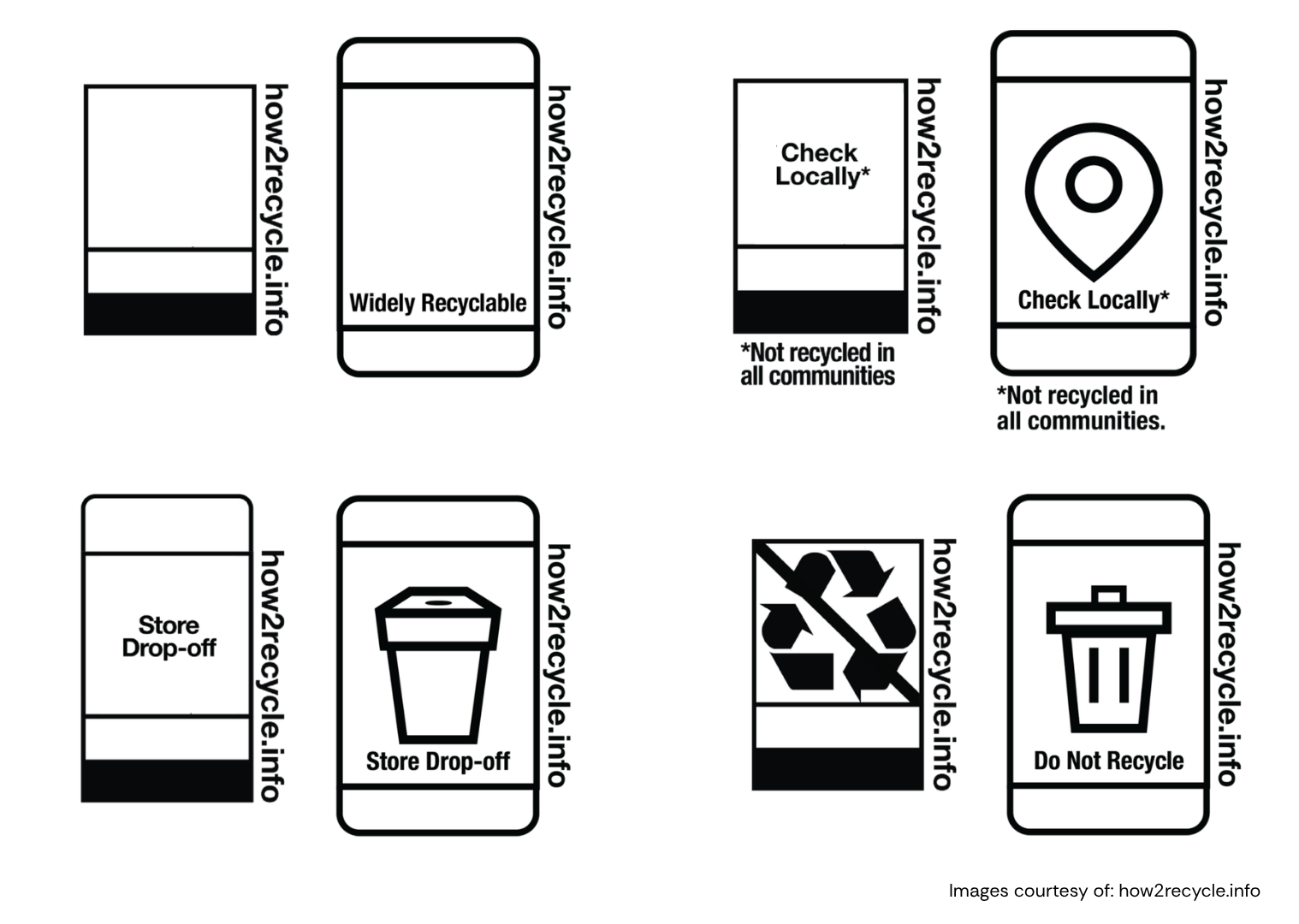
For brands, the implication is direct: on-pack messaging should describe a specific action, not a general aspiration. “Check locally” is not an instruction. “Empty, replace cap, recycle curbside” is.
Secondary Use: The Lifecycle Extension That Requires No Infrastructure

The most sustainable package often never reaches the waste stream at all.
Designing for secondary use allows packaging to continue delivering value without depending on recycling infrastructure. The economics are compelling: there are no collection costs, no sorting costs, and no processing losses.
A rigid box becomes storage. A tote becomes part of daily life. A pouch becomes a travel essential.
Prime Line’s 15-year packaging partnership with Free People offers a clear illustration of how far this effect can extend. A muslin bag — specified in unbleached cotton for both its minimal environmental impact and tactile appeal — moved into everyday use after customers began styling and repurposing it as a fashion accessory. The Free People “bag-to-top” trend spread across social media with 950K+ views and over 100K likes — a result driven by three design factors built into the specification from the start: durability, visual appeal, and relevance beyond the point of sale.
That combination is what separates packaging that gets discarded from packaging that stays in circulation — and extends the brand impression along with it.
Secondary use does not require new infrastructure. It requires deliberate design.
👉 Does your specification support the second life you’re expecting?
Designing for Recyclability: What the System Actually Needs
Understanding how materials recovery facilities (MRFs) operate changes design decisions.
These facilities sort, separate, and process materials at speed. If a material cannot be identified and separated efficiently, it will not be recovered — regardless of what the label says.
Mixed-material constructions are a primary failure point. Combining paper, plastic, and foil layers may improve shelf presence, but it often eliminates recovery viability. The data reflects this clearly. Paper and paperboard packaging in the U.S. is recovered at rates above 65%, according to the U.S. Environmental Protection Agency, largely because it aligns with established curbside infrastructure. By contrast, global plastic packaging recycling rates remain below 15%, as reported by the OECD — a figure heavily influenced by multi-material and flexible formats that sorting systems cannot efficiently process.
Coatings and laminations introduce similar issues. Treatments that enhance durability or moisture resistance can interfere with pulping and reprocessing, effectively removing an otherwise recyclable substrate from the stream.
Size is another sorting constraint. Items below roughly two inches frequently fail to move through MRF equipment and are screened out before they can be recovered.
Color is a less obvious but increasingly relevant variable. Dark pigments and carbon-black inks can interfere with near-infrared (NIR) detection technology used in modern sorting facilities, causing those items to be misidentified or rejected.
Paper-based formats — shopping bags, kraft boxes, mailers — remain reliable options precisely because they align with what existing infrastructure is designed to handle.
LCA-Lite: A Practical Evaluation Framework for Procurement
Full life cycle assessments are rigorous, but they’re rarely practical for day-to-day sourcing decisions. A shorter set of indicators provides usable signal without requiring a specialist or a significant time investment.
When evaluating materials or comparing suppliers, these five criteria create a consistent baseline:
Recycled content — What percentage of the material comes from post-consumer or post-industrial sources? Higher recycled content generally reduces virgin resource demand and embodied carbon.
Recyclability classification — Is the material accepted by curbside programs in your primary markets, or does it require drop-off or specialty processing? Theoretical recyclability and practical recyclability are not the same thing.
Material simplicity — Does the design use one material, or multiple bonded layers? Single-material formats are significantly easier to recover. Every added material type increases sorting complexity.
Weight efficiency — Is the packaging appropriately sized and specified for the product it protects? Over-specified packaging adds material cost, shipping weight, and end-of-life burden simultaneously.
Certification status — Does the material carry relevant third-party verification? FSC certification for fiber, APR recognition for plastics, and How2Recycle labeling for recovery guidance all provide auditable signal for sustainability reporting.
These criteria won’t replace a full LCA. But applied consistently, they create a procurement baseline that surfaces meaningful differences between options — and makes it easier to document and defend sourcing decisions.
For a deeper look at how Prime Line approaches material selection and sustainability, visit our sustainability page.
| Paper Shopping Bag | Corrugated Mailer | Poly Mailer | Flexible Pouch | Canvas Tote | Rigid Box | |
| Recycled Content | ●●●●○ | ●●○○○ | ●○○○○ | ●○○○○ | ●●●○○ | ●●○○○ |
| Practical Recyclability | High | High | Medium | Low | Reuse | Medium |
| Material Simplicity | High | High | Medium | Low | High | Low |
| Weight Efficiency | Medium | High | High | Excellent | Low | Low |
| Certification Status | FSC | FSC | APR | None | GRS | FSC |
What Not to Do
Even well-intentioned design decisions can sometimes undermine end-of-life performance. Most of these failure points are made early and only become visible later.
Combining materials that cannot be separated. Foil-laminated paper, plastic-coated board, and multi-layer flexible formats may look premium, but they typically cannot be recovered by existing infrastructure. If the material streams cannot be cleanly separated, the whole unit goes to landfill.
Relying on generic recycling icons. The chasing-arrows symbol communicates almost nothing actionable. It does not indicate local acceptance, required preparation steps, or which material stream the item belongs to. Consumers interpreting it as “this can go in my recycling bin” are frequently wrong — and the contamination that results can compromise entire batches of recoverable material.
Specifying finishes that interfere with recovery. Soft-touch coatings, UV gloss treatments, and certain foil applications can contaminate paper recovery streams. A box that is 90% recyclable paperboard but has a heavily coated surface may not be recoverable at all, depending on the facility.
Designing components too small to sort. Hang tags, small inserts, tissue paper layers, and narrow ribbon can all fall below the size threshold that MRF equipment is designed to capture. Designing these elements to be easily separated — or consolidated into the primary packaging — improves recovery rates.
Prioritizing aesthetics over recoverability without understanding the tradeoff. Visual differentiation is a legitimate goal. But teams that don’t evaluate how finishing choices affect end-of-life performance are making that tradeoff invisibly. The better approach is to surface the tradeoff explicitly and decide with full information.
What This Means for Your Business
End-of-life performance is no longer a niche sustainability issue. It is increasingly operational.
Retailer sustainability requirements are becoming more specific. EPR (Extended Producer Responsibility) regulations — already in effect in several U.S. states and significantly further advanced in the EU — are beginning to attach real costs to packaging that is not recoverable. Brands that cannot demonstrate recyclability or recovery performance are starting to face friction at the retailer level, higher EPR compliance costs, and exposure on the sustainability commitments they’ve made publicly.
The brands moving ahead are designing for real-world outcomes, not theoretical recyclability. They’re treating end-of-life as a specification criterion alongside print quality and structural performance — not an afterthought.
The Bottom Line
Recyclability is a specification. Recovery is a real-world outcome.
The gap between those two things is where most packaging sustainability claims can fall apart — and where the most meaningful design improvements are still available.
The next generation of packaging will be defined not just by what it is made from, but by what happens to it after use. That means asking harder questions at the design stage, understanding what the recovery system actually needs, and building end-of-life performance into the brief from the start.
Ready to Design Packaging That Performs in the Real World?
If you’re reviewing your packaging specifications against recyclability, retailer sustainability requirements, or upcoming EPR compliance obligations, it’s worth starting with the materials and formats in your current lineup.
At Prime Line Packaging, we work with brands to develop packaging that performs across its full lifecycle — from structural specification through end-of-life recovery. Whether you’re assessing an existing line or starting from scratch on a new format, we can help you understand where the real gaps are.